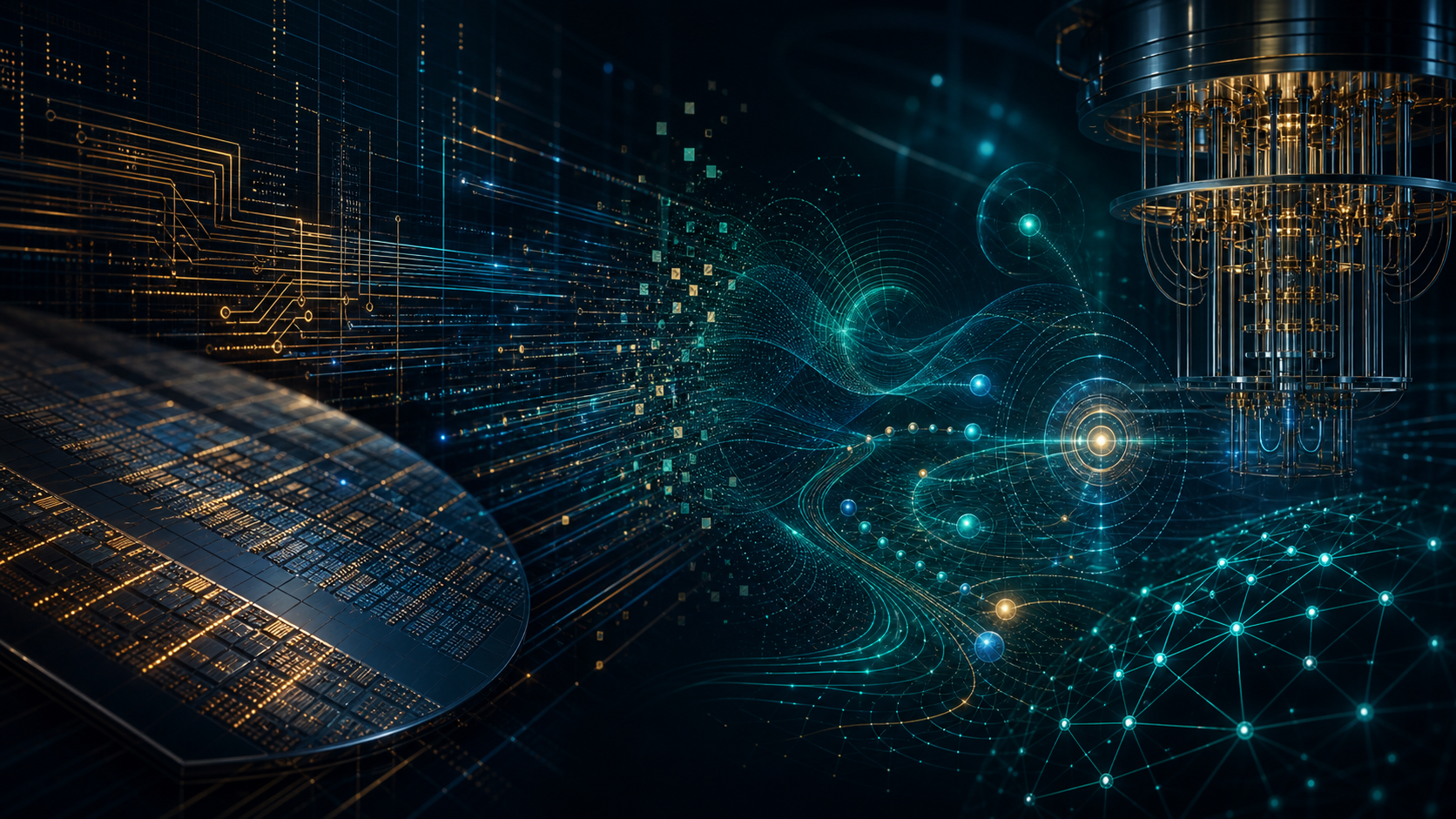
Why Does Quantum Computing Matter?
Classical computers have been the backbone of modern technology for decades. They power communications, finance, healthcare, manufacturing, logistics, defense systems, and nearly every digital service we use today. Yet some classes of problems remain extraordinarily difficult even for the most advanced classical machines. As complexity grows, computation can become prohibitively slow, expensive, or practically impossible.
Quantum computing is not simply a faster version of today's computing. It is a fundamentally different computational model built on the principles of quantum mechanics. Its importance lies not in replacing classical systems, but in expanding what may become computationally possible in a limited number of strategically significant domains.
That distinction matters. Quantum computing is unlikely to outperform classical systems in everyday business applications such as email, spreadsheets, ERP, web platforms, or standard enterprise analytics. Classical computing will remain dominant for the vast majority of workloads. The real promise is narrower and more consequential: quantum systems may eventually solve specific kinds of problems that classical machines struggle to solve efficiently.
Classical Computing Is Powerful, but Not Unlimited
Modern processors, GPUs, cloud systems, and high-performance computing clusters are extraordinary achievements. They are reliable, scalable, and continuously improving. But some problems scale badly. As the number of possible combinations, interactions, or states grows, the amount of computation required can increase dramatically.
In many cases, the challenge is not that classical computing is weak. The challenge is that the structure of the problem itself becomes difficult to represent or explore efficiently with classical methods. This is especially true for systems that are quantum mechanical in nature, such as molecules and materials, and for some optimization and search problems with very large solution spaces.
Classical computing still produces useful approximations in many of these settings. The question is whether a different computing model can handle some of them more naturally. That is what makes quantum computing strategically interesting.
From Classical Logic to Quantum Reasoning
One of the clearest ways to understand quantum computing is to start with classical logic. Classical computers process information through bits, each of which is either 0 or 1. Computation is built through logical operations using gates such as AND, OR, and NOT. These gates form digital circuits, and from those circuits we build everything from simple processors to modern computing infrastructure.
Quantum computing also uses gates, but the logic is richer because the unit of information behaves differently. Instead of a bit, a quantum computer uses a qubit. Unlike a classical bit, a qubit does not have to be fixed as only 0 or only 1 before measurement. It can exist in a superposition, meaning its state is described as a combination of possible outcomes. When qubits interact, they can also become entangled, meaning their states are correlated in ways that cannot be described independently.
So the shift from classical to quantum computing is not a shift away from logic. It is a shift into a broader computational logic. In classical logic, gates transform definite binary values. In quantum logic, gates transform probability amplitudes, phase relationships, and correlations between qubits.
Quantum Gates and What They Tell Us
A practical universal gate set in quantum computing often includes gates such as the Hadamard gate, the CNOT gate, and the T gate. These are the building blocks from which quantum circuits are assembled.
The Hadamard gate prepares a qubit in a superposition, creating a state that can later be measured as 0 or 1 with specific probabilities. The CNOT, or Controlled-NOT, gate conditionally flips one qubit depending on the state of another. This is fundamental because it helps create entanglement, one of the core resources of quantum information processing.
The T gate and related phase gates modify the phase of a qubit. Phase has no direct equivalent in classical digital logic, but in quantum computing it matters enormously because phase relationships influence how quantum states interfere during a computation. This is part of what gives quantum circuits their expressive power and makes them so different from classical circuits built only on fixed binary values.
Why Is Quantum Speed Different?
When people hear about quantum computing, they often hear the word speed. That word needs careful handling. Quantum computers are not expected to make all computing faster, and they are not a universal upgrade to classical IT. Their significance comes from the possibility of speedup for certain categories of problems.
That matters because in some fields, solving one difficult problem faster can create outsized economic or strategic value. If a system can reduce the time needed to simulate a molecule, optimize a logistics network, explore a large search space, or model a physical process, the impact may be measured not only in performance but in better decisions, faster innovation, and stronger competitive position.
So the real question is not whether quantum computers are faster in general. The question is whether they can become meaningfully better at the right problems. That is where the field's long-term value lies.
Why Is It So Hard to Build?
If the promise is so significant, why is quantum computing still early? Because building a useful quantum computer is one of the most demanding engineering challenges in modern technology.
Qubits are fragile. They are highly sensitive to noise, vibration, temperature fluctuations, electromagnetic interference, and control errors. Depending on the hardware approach, they may need ultra-cold environments near absolute zero, vacuum systems, lasers, microwave control, or highly specialized fabrication and packaging methods.
Then there is the issue of decoherence. Quantum states do not remain stable forever. They lose information through interaction with their environment, and when that happens computation becomes unreliable. This leads directly to one of the central challenges in the field: quantum error correction. Useful large-scale computation will require not only more qubits, but also more reliable logical qubits built on top of noisy physical hardware.
Why Does It Matter Now?
Even with these challenges, quantum computing is no longer a purely theoretical field. Real hardware exists today. Major technology companies and specialized firms are building different kinds of quantum systems. Access is available through cloud platforms. Researchers, developers, and enterprises can already run experiments, test algorithms, and build early familiarity with quantum workflows.
That does not mean large-scale commercial disruption is already here. It means the field has moved from abstract promise to early strategic infrastructure. Foundational technologies matter before they are fully mature, because organizations that understand them early are often better positioned when they become practical.
Quantum computing matters now because the direction of travel is becoming clearer, even if the endpoint is not yet fully in reach.
Conclusion
Quantum computing should be understood with both ambition and discipline. The ambition comes from its potential to solve selected classes of problems beyond the practical reach of classical computing. The discipline comes from recognizing how difficult the engineering challenge still is.
Quantum computing is not important because it will replace classical computing. It is important because it may redefine what becomes computationally achievable in a small number of strategically critical domains. And if that happens, the consequences will extend well beyond computing itself.
Quantum computing is not yet the new standard. But it is already becoming a serious strategic frontier.
If you are assessing where quantum, AI, or advanced computing should fit in your roadmap, investment thesis, or capability agenda, we can help frame the decision with strategic and technical clarity.
Request a confidential discussion